Why Atlanta Real Estate Agents Pay So Much More for FMLS than GA MLS, and What Most of Us Were Never Told
An Insider’s Perspective
To my fellow Atlanta real estate agents: a lot of you know I have been on a slow simmer for a couple of decades about what I see as the structural problem that is FMLS. Every time I think I have reached the end of it, something new pops up that reminds me how deep this thing actually goes.
What You Can See for Yourself: Syndication Quality Matters
Here is the latest example, and it is something you can see with your own eyes. Did you know that FMLS syndicates your listing photos to third-party sites at a noticeably lower resolution than Georgia MLS? Go to Zillow and look at any listing that is primarily syndicated by FMLS. Then pull up, side by side, any listing that is syndicated by GA MLS. The difference is not subtle. GA MLS images are crisp and clean. FMLS images are softer and muddier. The quality loss is obvious.
There is more. When GA MLS syndicates a listing, they include the listing agent’s phone number alongside the agent’s name and brokerage. When FMLS syndicates a listing, they do not. So if you have ever wondered why your phone rings less than it should, start by checking which MLS feed is powering your listing.
Why This One Detail Points to a Bigger Problem
Now let’s zoom out, because this quirk is only one thread in a much bigger tapestry, especially when it comes to two things. First, why one of our Atlanta-area MLSs is exponentially more expensive than the other. Second, why our collective perception of the value delivered by one versus the other seems so carefully skewed.
Two MULTIPLE LISTING SYSTEMS, Two Eras
To understand how we got here, it helps to look back at the years these two MLSs were born. FMLS in 1957. GA MLS in 1962. Those dates alone should get your mind turning. The late fifties and early sixties were not exactly an era known for universally inclusive business structures in the South. I could say more, but let me just offer a hint.
Think of one very powerful social influence on policy making at that time. A three-syllable word that starts with an R. No, not redlining. Warm, but no cigar. The other one. Yes, you are on the right track, but you did not hear it from me.
What follows is my interpretation, based on years of research, math, and conversations with people who were around when these systems were formed.
A Funding Model Unlike Almost Any Other MLS
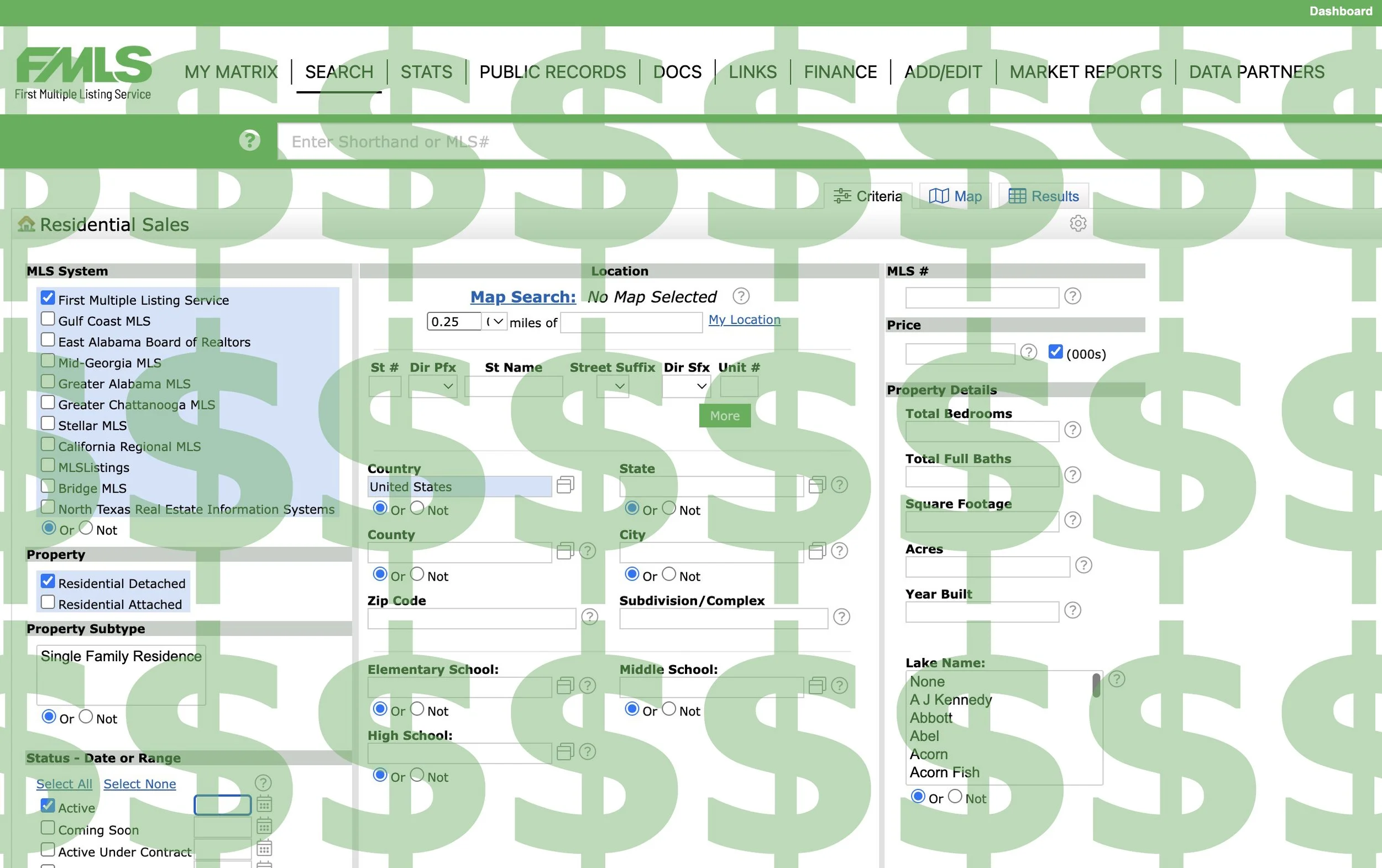
Instead of creating a membership-based MLS like practically every other system in the country, the original founding brokers of FMLS designed something unusual. They tied the cost of participation directly to the sales price of every listing entered into the system. In 1962, when the median Atlanta home price was about $18,200, the 0.12 percent fee came out to $21.84 for the listing broker. Once buyer brokers were formally recognized, they paid the same amount if they were participating members.
Not a lot, right? Small enough to pass without pushback. Consistent enough to scale. Brokers passed the cost through to their agents, and the system grew. After collecting these percentage fees, FMLS paid its basic expenses, rebated a portion back to participating brokers, and retained the remainder under a structure that has never been particularly transparent to agents funding it.
What That Fee Structure Actually Did
Functionally, this fee model did four things at once. It established a perception of superior value over adjacent MLSs for what was, at the time, the same underlying product. It created a recurring revenue stream for member brokers through monthly rebates. It created an early barrier to entry for agents and brokerages that could not afford transaction-based fees. And it established a long-term financial structure that continues to benefit the original founding interests behind the MLS.
Fast Forward: Same Model, Much Bigger Numbers
Fast forward to today. The model has barely changed, only the numbers have. With median intown prices hovering around $500,000, FMLS collects $1,200 on a two-sided transaction. You see it deducted from your commission check and shrug it off as the cost of doing business. Meanwhile, that single transaction generates double the annual cost of GA MLS for both the listing agent and the buyer’s agent combined.
Of that $1,200, only a small fraction is required to operate the system itself. Roughly half is rebated back to participating brokers. What happens to the remaining portion is not something FMLS openly discusses, but the math makes clear that the original structure continues to generate substantial financial benefit well beyond basic operations.
How Broker Incentives Shape Agent Behavior
This is where modern brokerage behavior comes into play. Offices receiving large monthly rebates naturally promote FMLS as the superior system, even though the rebate has nothing to do with feature quality or consumer benefit. It is simply money coming in the door. For some offices, this represents a small percentage of revenue. For others, it is meaningfully higher. That reality shapes brokerage culture and quietly influences what agents are encouraged to value.
Why GA MLS Often PLAYS SECOND FIDDLE
The irony is that many of these same brokerages sit squarely within GA MLS participation areas, yet agents are allowed or even encouraged to skip GA MLS entirely when inputting listings. This is despite the fact that GA MLS costs only $25 per month for unlimited listings and closings and provides better photo syndication and stronger agent visibility.
Why skip it? Habit. Narratives passed down through brokerages. A misunderstanding of who benefits from which system. And, in some cases, quiet encouragement to rely on the MLS that financially benefits the brokerage more directly.
A Personal Conversation That Changed My Perspective
Years ago, I met with GA MLS leadership after speaking with a former 1960s president of the Dekalb County Board of Realtors, which played a major role in the founding of GA MLS. I encouraged GA MLS to modernize its interface, strengthen compliance enforcement, and even consider raising the monthly fee from $25 to $35 to fund broader training and user-experience improvements.
The reaction was telling. Not because these were not their stated goals, but because they made it clear that the existing fee structure already generated more than enough revenue to fund operations, development, and growth. That conversation confirmed two things for me. First, an MLS does not require massive transaction-based revenue to function well. Second, the perception that GA MLS is “inferior” has far more to do with usage patterns than actual capability.
What AN MLS Actually CostS to Run
The truth is simple. Hundreds of MLSs nationwide operate efficiently on flat monthly fees between $25 and $100 per agent. The additional revenue generated by a percentage-based MLS is not necessary to operate an MLS. It only makes sense if the system was designed to accomplish something beyond basic service delivery.
The Question Every Agent Should Ask
So here is the real question. When you take a listing, which MLS best serves your client? Is it the system born in a historical context that should give anyone pause and funded by a structure that imposes unnecessary costs on agents? Or is it the system that delivers cleaner syndication, stronger agent attribution, lower fees, and a broader data set?
If your broker requires both, fine. But if you find yourself insisting that one MLS is inherently superior, take a breath and ask where that belief came from. Training. Tradition. Or the quiet influence of a revenue model that benefits brokerages and legacy interests far more than the agents whose production funds it.
Pay attention to which listings appear only in FMLS. Ask why. Ask who benefits. Ask who pays.
Final Thought
If change ever comes to Atlanta’s MLS landscape, it will not come from the top. It will come from agents who finally understand the system they are feeding and choose to use the MLS that exists to support them, not extract from them.